
Vegan Korean skincare means products made without any animal-derived ingredients, such as snail mucin, honey, propolis, beeswax, lanolin or collagen of animal origin. To choose it, look for a clear vegan statement, read the full ingredient list, and then match the product to your skin type as you would with any skincare. Vegan does not automatically mean cruelty-free, fragrance-free or gentle. In this guide, a product counts as vegan only when it is listed as vegan by our supplier.
What does vegan mean for Korean skincare?
For cosmetics, vegan means the formula contains no ingredients that come from animals, including things animals make, such as honey, beeswax or milk. It describes what is inside the bottle, not how the product was tested or whether it suits your skin.
Korean skincare uses many plant ingredients, such as centella asiatica, green tea, rice and aloe, so a lot of K-beauty looks plant-based. But some well-known Korean ingredients come from animals, and one is enough to make a product non-vegan. A vegan statement from the brand, or a vegan listing from the supplier, tells you more than a leaf on the box.
EU cosmetics rules do not give "vegan" one fixed legal definition, so brands rely on their own statements or on independent vegan certification. Some product descriptions spell this out: the Mary&May toner and sun cream below both say "Vegan certification completed".
Is vegan skincare the same as cruelty-free or "clean"?
No. The three words answer different questions:
- Vegan is about ingredients: nothing from animals in the formula.
- Cruelty-free is about testing: the brand says it does not test its products or their ingredients on animals. A cruelty-free product can still contain honey or beeswax, and a vegan product is not automatically cruelty-free.
- "Clean" has no agreed or legal meaning in cosmetics. Brands use it in different ways, so on its own it tells you very little.
Some products carry both statements: Benton describes its Aloe Hyaluron Cream as vegan and cruelty free, and haruharu wonder says the same about its Black Rice products in this guide. If both matter to you, look for both, because one does not prove the other.
Which animal-derived ingredients should you check for in K-beauty?
These are the ones you are most likely to meet in Korean skincare and makeup, with the names they often carry in the ingredient list.
| Ingredient | On the label | Where it comes from |
|---|---|---|
| Snail mucin | Snail Secretion Filtrate | Snails |
| Honey, propolis, royal jelly | Honey Extract, Propolis Extract, Royal Jelly Extract | Bees |
| Beeswax | Beeswax, Cera Alba | Bees |
| Lanolin | Lanolin | Sheep's wool |
| Collagen | Collagen, Hydrolyzed Collagen | Often fish or other animals, unless the brand says otherwise |
| PDRN | Sodium DNA | Traditionally salmon or trout; plant-based versions also exist |
| Carmine (mostly in makeup) | CI 75470 | Insects |
A few ingredients can come from plants or animals while the label name stays the same, for example squalane (olive, sugar cane or shark liver), glycerin, stearic acid and some ceramides. Hyaluronic acid was once taken from rooster combs, but today it is mostly made by fermentation. Watch for the opposite trap too: "Synthetic Beeswax" is a lab-made wax, not something from bees. When in doubt, rely on a vegan statement for the whole product. Our guide to PDRN in skincare covers one of these ingredients in more detail.
How can you tell if a Korean skincare product is vegan?
- Look for a clear vegan statement. A brand statement, certification mark or supplier listing says more than words like "natural".
- Read the full ingredient list. Scan it for the names in the table above.
- Check what the claim covers. Phrases like "vegan sheet" or "plant-based oils" may describe only one part of a product, so make sure the statement covers the whole formula.
- Ask when an ingredient could go either way. If the source of squalane, collagen or a ceramide matters to you, ask the brand, or ask us through our contact page.
Is vegan skincare gentler on sensitive skin?
Not automatically. Fragrance materials, essential oils and some plant extracts can bother reactive skin, and a vegan product can contain all of them.
The products in this guide show the difference. haruharu wonder's regular Black Rice Hyaluronic Toner lists alcohol and lavender oil, while the For Sensitive Skin version has neither in its ingredient list. Mary&May's blemish toner lists mint oil (Mentha Arvensis Leaf Oil) alongside exfoliating acids. All of them are listed as vegan by the supplier, yet they suit different skin.
If your skin stings or reddens easily, choose formulas whose ingredient list includes no fragrance or essential oils, add one new product at a time, and patch test first: apply a little behind the ear or on the inner arm for a few days before using it on your face. Our sensitive skin collection has more gentle options; check each one for a vegan statement, because not all of them are vegan.
How do you choose vegan Korean skincare for your skin type?
Start from your skin, not the label. The table shows how the examples in this guide line up by need. Every product named here is listed as vegan by the supplier.
| Your skin or need | Examples listed as vegan | Good to know |
|---|---|---|
| Dry or tight, especially in winter | Torriden hyaluronic acid cleansing foam, haruharu wonder toner for sensitive skin, haruharu wonder Black Rice cream | The cream lists lavender oil |
| Oily or prone to breakouts | haruharu wonder cleansing oil, Mary&May blemish toner, Benton aloe cream | The toner has AHA, PHA and mint oil, so start slowly |
| Sensitive and quick to sting | haruharu wonder cleansing oil, haruharu wonder toner for sensitive skin, Benton aloe cream | None of the three lists fragrance or essential oils |
| Daily sun protection | Mary&May CICA sun cream | SPF50+ PA++++ with organic (chemical) UV filters |
| Dry hands from cold and heating | illiyoon ceramide hand cream | Unscented, with ceramide and shea butter |
Cleansers
For the evening first cleanse, haruharu wonder Black Rice Moisture Cleansing Oil 150ml is an unscented oil made with nine ingredients, led by rice bran oil with sunflower, olive, jojoba and macadamia oils. You massage it over dry skin, then add a little water so it turns milky and rinses away makeup and dirt. The brand describes it as vegan and cruelty free.
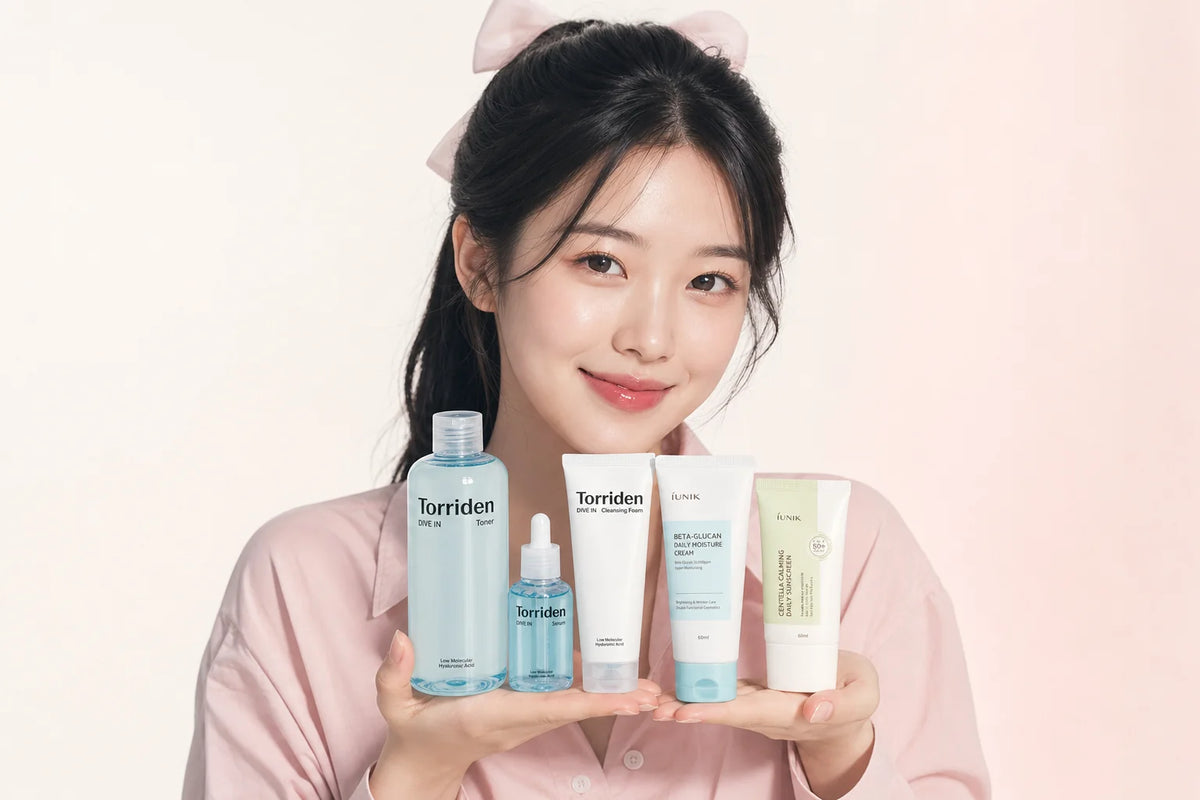
For the second cleanse or a morning wash, Torriden DIVE IN Low Molecular Hyaluronic Acid Cleansing Foam 150ml combines eight types of hyaluronic acid with amino acid cleansing agents derived from coconut. Torriden says it leaves skin moist rather than tight after washing. Its ingredient list includes no fragrance.
Toners
haruharu wonder Black Rice Hyaluronic Toner For Sensitive Skin 150ml is a light, hydrating toner with betaine, fermented black rice extract, hyaluronic acid and beta-glucan. As the name says, this version is meant for sensitive skin, and the brand suggests patting it in with a cotton pad after cleansing. Its ingredient list includes no fragrance or essential oils.
For oily skin or skin prone to breakouts, Mary&May Vegan CICA Tea Tree AHA PHA Blemish Toner - 200ml is a mildly acidic toner with tea tree leaf water, niacinamide and centella asiatica. The brand says its AHA and PHA help lift away excess sebum and dead skin cells. It also lists mint oil, so patch test it, start with a few evenings a week, and do not layer it with other exfoliating acids or retinoids. Our guide to skincare ingredients not to mix has more on combining active ingredients.
Moisturizers
Benton ALOE HYALURON CREAM 50g is a light cream with 40% aloe leaf water and a complex of seven types of hyaluronic acid. Benton lists it as free of fragrance, essential oils, silicone and animal products. The brand describes a soft white cream that absorbs quickly, worth a look if heavy creams feel like too much.
For drier skin, haruharu wonder Black Rice 10 Hyaluronic Cream - 2Size pairs fermented black rice extract with hyaluronic acid, evening primrose oil and safflower seed oil. The brand aims it at flaky skin and skin that feels dry inside, and describes a mild cream that spreads smoothly and finishes without stickiness. Its ingredient list includes alcohol and lavender oil, so patch test it if your skin is sensitive.
Sunscreen
Mary&May CICA Soothing Sun Cream SPF50+ PA++++ - 50ml goes on as the last step of your morning routine. It contains a cica complex based on centella asiatica, plus niacinamide and sodium hyaluronate. Its UV filters are organic (chemical) ones, not zinc oxide or titanium dioxide, and its ingredient list includes no fragrance. The brand suggests a generous layer on the areas that get the most sun.
Hands
illiyoon Ceramide Unscented Vegan Handcream 50ml contains ceramide and shea butter, and the brand says it is made without animal raw materials or fragrance. The brand says it is not sticky and absorbs quickly, so it is easy to use after every hand wash.
What does a simple vegan Korean skincare routine look like?
You do not need ten steps. A vegan routine follows the usual Korean order, from thinnest to thickest texture:
- First cleanse (evening): a cleansing oil on dry skin to remove sunscreen and makeup.
- Second cleanse: a gentle foam, morning or evening.
- Toner: a hydrating toner patted in daily, or an exfoliating toner a few times a week.
- Moisturizer: a light cream for oily skin, a richer one for dry skin.
- Sunscreen (morning): always the last step.
For more choice, browse our skincare collection, cleansers and sun protection, and check each product's vegan statement before you buy, since many are not listed as vegan. Not sure of your skin type? Try our skin quiz.
How should vegan skincare change with the Nordic seasons?
Cold outdoor air and dry indoor heating make Nordic winters hard on skin. If your face feels tight, keep the cleanser gentle, add a second layer of hydrating toner and use a richer cream at night. Keep a hand cream by the sink, since hands often feel it first.
The winter sun is low and weak, but from spring onward it gets stronger quickly, so make sunscreen a daily morning step from then on. Snow also reflects sunlight on bright winter days and ski trips.
FAQ
Is snail mucin vegan?
No. Snail mucin, listed as Snail Secretion Filtrate, comes from snails, so products that contain it are not vegan. For a hydrating step without it, look for a product with a vegan statement built on plant ingredients or hyaluronic acid.
Is hyaluronic acid vegan?
Usually, but the label does not show the source. Most hyaluronic acid today is made by fermentation rather than from animals. A vegan statement for the whole product is the simplest check.
Is centella asiatica vegan?
Centella asiatica, often called cica, is a plant, so the ingredient itself is plant-based. Whether a cica product is vegan depends on everything else in the formula, so check the full list or a vegan statement.
Are Korean sunscreens vegan?
Some are. Mary&May's CICA Soothing Sun Cream is listed as vegan by the supplier. Many others make no vegan statement, so look for one and check the ingredient list for beeswax or lanolin.
Is every product Keauty sells vegan?
No. Only some products in our range are listed as vegan by our supplier, and many others contain ingredients such as beeswax, honey extract or collagen. Check each product's description and ingredient list, or contact us if you are unsure.
Keauty sells some of the products mentioned here.
This is general cosmetic information. Skin differs from person to person, so patch test new products and ask a doctor or pharmacist about any skin condition.